
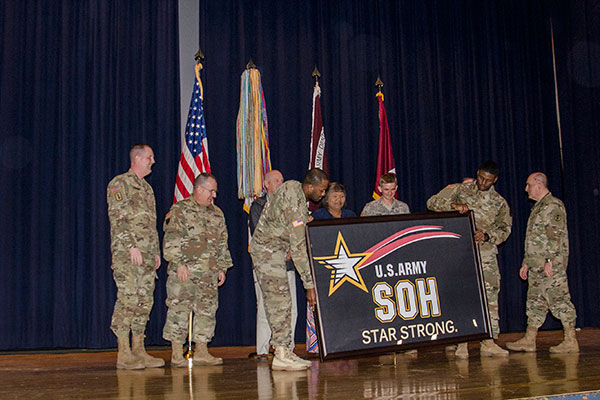
Brigadier Gen. Erick Torring, deputy commanding general for Regional Health Command-Atlantic, presented U.S. Army Dental Health Activity Fort Campbell with the Army Safety and Health Management Star Friday at Wilson Theater.
The award is recognition of Fort Campbell’s DHA having realized a workplace that complies with the ASHMS motto of “a world class safety and occupational health program.” The program is the Army’s implementation of the Occupational Safety and Health Administration’s Voluntary Protection Programs, which protects Soldiers, Army civilians and contractors from hazards in the workplace.
Achieving star status required the completion of 243 tasks divided among three phases and it demonstrates that the Fort Campbell DHA safety program is truly outstanding. To earn the ASHMS it takes all employees embracing a culture of safety. The program measures organizations in four areas: management commitment and employee involvement, hazard prevention and control, worksite analysis and safety training.
Colonel Jose Conde, commander of Dental Command-Atlantic, Col. Tom Goksel, Fort Campbell’s DHA commander, and senior enlisted personnel also took part in the ceremony.
Goksel singled out two individuals for their efforts in facilitating the changes needed to elevate the DHA’s safety program to the level of excellence needed to earn the ASHMS, Capt. Joshua A. Akers general dental at Adkins Dental Clinic and DHA safety officer, and retired Col. Nathan Methvin.
“Colonel Methvin and Capt. Akers have over the course of two years each spent in excess of 500 plus hours to develop safety policies, inspecting clinics accident reports, hazard tracking mechanisms, accident near miss reporting [and] algorithms. They performed statistical trend analysis, reported accidents and incidents all to help minimize job hazards in the workplace,” Goksel said. “Without the tireless efforts of these individuals, we would not be here achieving the star status.”
Goksel said that out of 7 million worksites across the nation, the Fort Campbell DHA is one of 2,200, or .03 percent, of worksites that went through the rigorous process of attaining star status. The Fort Drum, New York, DHA is the only other DHA to have earned the ASHMS.
Torring praised the efforts of RHC-A for their safety efforts, noting that both the Fort Campbell and Fort Drum DHAs are part of RHC-A. He also reminded attendees that it was a collective team effort to earn the ASHMS.
“There are those on the stage here who are being recognized, but to receive this took every one of you,” Torring said. “Every one of you had a part in this. Every one of you should be extremely proud of this.”
One challenge in implementing the necessary procedures and controls to protect employees from hazards at the level required by the ASHMS was that Akers had no prior experience as safety officer.
“Part of what made this cumbersome is that we initially didn’t even understand the verbiage of the requirements, much less how to approach it,” Akers said. “Colonel Methvin and I were dentists with no formal safety training, so this was a totally new experience. We had to learn as we went and that was the hardest part about it. We spent many hours gradually chipping away at the project, trying to figure out what was being asked of us and then how to fulfill the requirements and complete the tasks.”
Akers said the part of the reason for success was the great support he received from auxiliary services on post. He consulted with the Blanchfield Army Community Hospital safety team, industrial hygiene, environmental health and Fort Campbell’s Fire and Emergency Services where he worked with both the military police and fire department, as well as others.
It was an arduous process, which Akers said made him a better Army officer. It tested his discipline, his ability to lead, and his competence to develop policies and engage with the unit and auxiliary services.
It was a multifaceted effort, which improved the safety at the DHA.
“You have to get management commitment, employee involvement, and have policies written and implemented,” Akers said. “And then there is the training, the worksite analysis, determining what the hazards are and developing ways to mitigate those hazards, which is where industrial hygiene comes in and then hazard prevention and control.”
Akers said it also took developing methods to track and report hazards, including accident and near-miss algorithms, as well as statistical and trend analysis of incidents to develop controls and engage in continuous improvement in the mitigation of hazards employees may face at work. Hazards can include everything from relatively innocuous tasks such as knowing how to ergonomically use equipment in the workplace to knowing how to respond to an active shooter.
“The greatest challenge is engaging all personnel, because everyone has to be aware of the components of the Army Safety and Health Management System,” Akers said. “To achieve this, you have to be able to demonstrate at least three ways that each personnel is actively engaged.”
Akers said that momentum and excitement about the program increased as the unit approached the final phase three inspection.
“The environment here was electric,” Akers said. “People had study guides, they were studying, quizzing each other and people set aside differences and personal ambitions to achieve the end goal. They just worked together cohesively and in a way I hadn’t seen before. So really the phase three assessment is where the magic happened.”
The benefit of the program is that the DHA is actively involved in ensuring safety, reporting hazards, near-misses and anything that could cause injury to the workforce. Not only does this protect employees, but by preventing injury it helps the Army sustain combat readiness.
“It’s fantastic, but I agree with the command team. Honestly it wasn’t about me. Everyone here had to be an active participant,” Akers said. “The point of all of this is to keep everyone safe.”