
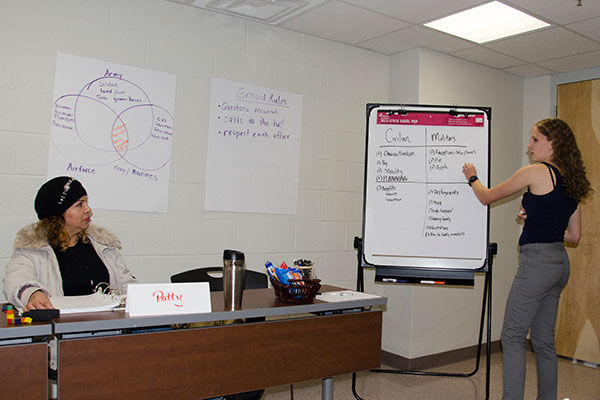
Army Community Service Army Family Team Building hosted its Army 101 class Monday and Tuesday.
ACS-AFTB offers Army 101 twice a month to spouses and dependents of Soldiers to provide them with basic Army knowledge to help them adapt to military life.
During the two-day session, participants take four classes each day, from 9 a.m. until 1 p.m. On the first day they learned about resiliency, military acronyms and terms, military time, military ranks, the chain of command and military benefits. On the second day participants learned about military social functions, military customs, courtesies and traditions, information about Family readiness groups and military Family preparedness amongst other topics.
Volunteers teach the classes and draw on their own experiences with the military to provide relevant answers and examples to participants in Army 101. It is a way for volunteers to give back to the community and help people new to military life adjust to the transition from civilian life.
Alex Conely, a volunteer instructor for Army 101, served in the Army for five years, including two years at Fort Campbell. He was a cavalry scout before he fell 500 feet down a mountain side in Fort Erwin, California, during a training exercise in 2013.
Conley spent more than a year recovering at Walter Reed National Military Medical Center. He had to relearn how to walk, talk, read and write. He was assigned a service dog named Toby, and continued to service in the military for more than a year including being a supply specialist at WRNMMC and at the Warrior Transition Battalion at Fort Campbell.
“What I found with my military life, was when I would come home and spew all of this [military jargon], I would isolate my spouse and she would just yes me to death,” Conley said. “She would have no idea what was going on at work.” However, by having the chance to explain basic aspects of military life to spouses, like how to read an Army leave and earning statement, or to know more about Army benefits and entitlements, Conley said it will allow spouses to become more proactive and have better communication with their spouse. This will gives spouses the knowledge to become more involved with the military community.
“I feel like it will create a better and strong bond between the Soldier and his [or her] spouse because I now they are both communicating on the same level,” Conley said. “It will give them the strength to continue to have a successful relationship as opposed to the common trend of divorce as we see.”
Richelle Lowe, was one of the spouses participating in Army 101. She is newly married and is still learning about military life. She came into the class with the sum of her military knowledge being a few acronyms.
“This is a part of my husband’s life and now a part of my life, so I wanted to have the information that I need to be able to enjoy all of the benefits and understand what military life is all about,” Lowe said. “I married him. I love him and I just want to understand him.”
Many aspects of the military seemed alien and hard to understand to the participants at first. Military time, the military phonetic alphabet, rank insignias and most military acronyms were wholly foreign concepts when the classes started, but it did not take long before the Army 101 students were converting time to military time, spelling words using the military phonetic alphabet and deciphering the difference between benefits and entitlements.
Patty Rivera is not a spouse, but a dependent and she has been associated with the military for two years while living in Germany with her daughter who is a U.S. Army officer. They have recently moved to Fort Campbell and she sought out the Army 101 class to gain more understanding about her daughter’s profession.
“All of these classes are very helpful to explain to all of us that are nonmilitary associated or experienced. They explain in detail [and] all of our questions are answered,” Rivera said. “For all of us that have no idea what we’re dealing with they are very explanatory and I would recommend [the classes] ... especially people coming from overseas or the young people that they don’t know where to look or what to do.”
What Lowe liked most about the Army 101 is that it demonstrates Fort Campbell takes care of its Soldiers and Families by providing them useful resources.
“I appreciate it very much that they took the time to actually care about the spouses and that they’ll actually know the information that their husbands’ know.” Lowe said. “[It] shows they have respect for the Families that go behind these Soldiers.”
For Conley volunteering and being able to use knowledge he says the Army “invested a great deal of monetary value in to teaching me” gives his life purpose. For him volunteering is how he lives out the Soldier for Life idea.
Conley said ACS has been welcoming of him and has accommodated Toby. In the newly renovated building, the elevator allows him to reach the second floor where he teaches his class, which he said he greatly appreciates. By meeting Conley’s need he in turn provides Family members with information that can help with financial decisions, improved communication with their Soldier and can connect participants to resources that will increase the entire Family’s resiliency.
“[The Army] still remains a part of me and I can take that part of me and give it back to others,” Conley said. “Programs like this make the Army. Even though it’s a benefit, it takes the Army and puts into perspective for a lot of spouses and services members that don’t know a whole bunch. I feel like the Army expects them to know it once they come in, but that’s not the spouses’ job and programs like this make a world of difference.”
CLASS schedule
The next Army 101 is March 20-21. All participants must register prior to attending the class. To register for the class or for more information about Army 101 or Army Family Team Building, call 270-798-4800, email ftcampbellaftb@gmail.com or visit the AFTB office at the ACS building on 2601 Indiana Ave.